SUP Hong Kong: 2026 Beginner’s Guide to Stand-Up Paddle
Updated: 2026-05-25
Stand-up paddle (SUP) is the easiest entry point into Hong Kong’s water sports world — easier than surfing, calmer than windsurfing, and friendlier than open-water kayaking. But Hong Kong SUP comes with one industry-standard twist: recognised water-sports operators won’t rent a SUP board to you independently until you hold a SUP Beginner Certificate. This guide explains why that certificate exists, how to earn one through a two-hour course at Sha Ha or another approved venue, and where you can paddle solo once you’ve got it. Written by Blue Sky Sports Club, which co-organises the certificate course with the Hong Kong, China Surf and Standup Paddle Association — so the practical details (cost, schedule, what the assessment covers) are first-hand, not second-hand.
What Is SUP, Really?
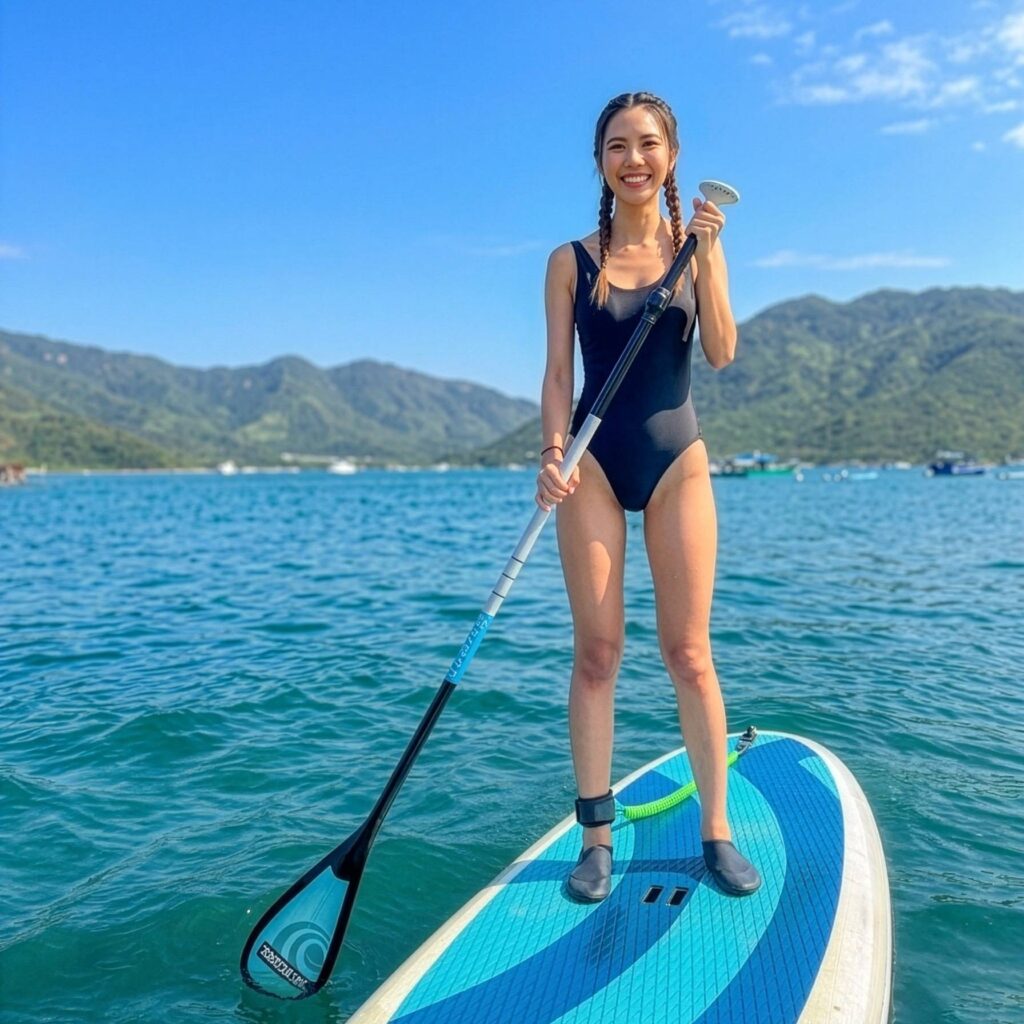
Stand-up paddle (SUP) is exactly what it sounds like: you stand on a wide buoyant board, hold a single long-shaft paddle, and propel yourself across the water by alternating strokes left and right. The board is typically 9 to 12 feet long for beginners — long enough to be stable, short enough to turn. The standard learning shape used at Blue Sky Sports Club and other Hong Kong SUP courses is an all-around board around 10’6″ with a soft top deck pad. SUP rewards balance and patience rather than strength — kids from age 6 and adults of any age can both do it competently with two hours of instruction. The activity sits in an interesting niche: calmer water than surfing (where you need waves), less gear than windsurfing (one board + one paddle, no rig), and more upright than kayaking (you see the water differently from a standing position). For most Hong Kong learners, SUP is the gateway drug to spending weekends on a paddle.
Why Hong Kong Requires a SUP Beginner Certificate
Recognised Hong Kong water-sports operators require SUP renters to demonstrate basic competence before being handed a board for solo use. This is enforced through the SUP Beginner Certificate, issued by the Hong Kong, China Surf and Standup Paddle Association — the national sports association that Blue Sky Sports Club co-organises its SUP Beginner Program with. The rationale is straightforward — a rider who falls in 200 metres offshore, can’t remount the board, and panics is a Marine Police call that ties up rescue resources for hours. The certificate confirms basic competencies: standing up on a moving board, paddling in a straight line, performing a basic stop, deliberately falling in and remounting, and recognising unsafe conditions. The certificate doesn’t expire, and you need it for any independent SUP rental.
5 Steps from Zero to Solo SUP Renter
Here is the most direct 2026 path from never-paddled to confidently renting a SUP on your own. Most people complete the course and on-water assessment in a single Saturday morning; the certificate is issued after course completion. Step 4 is your first solo rental day; step 5 unlocks the wider Hong Kong paddle scene. The whole pathway typically takes one Saturday plus one short follow-up trip — fast for a sport whose payoff lasts decades.
Pathway at a glance:Step 1–3: Course + assessment + cert (issued after the course) · Step 4 (any day after): First solo rental · Step 5 (after 3–5 sessions): Guided tours / longer routes
Book a SUP Beginner Certificate Course. Two hours; Blue Sky’s group class is from HK$550. Min 4 people per group, coach-to-student ratio 1:8. Choose a calm-water venue — Sha Ha or a similar protected bay. Group classes run on weekend mornings; private classes (from HK$850) are also available.
Complete the on-water assessment. Your instructor will run you through stand-up, basic stroke, stop, deliberate fall and remount, and a straight-line paddle on flat water. The class is built around getting a complete beginner from never-paddled to covering all the basics in one session.
Collect your certificate. After the course, the Hong Kong, China Surf and Standup Paddle Association issues your digital SUP Beginner Certificate. Save it to your phone — operators check it at sign-out.
Book a solo SUP rental. Sha Ha SUP rental starts at HK$300 full-day; at GO PARK Aqua, half-day from HK$190 / full-day from HK$380, both inclusive of the facility. First solo day, stay inside the bay and paddle close to the launch point — the rental staff will give you a route brief.
Expand to tours or longer routes. Once you have 3–4 confident solo sessions under your belt, you’re ready for guided tours that go to Sharp Island, Yim Tin Tsai, or further. These tours run through Blue Sky Sports Club and other operators.
Where to Take the SUP Beginner Certificate Course in Hong Kong
Several Hong Kong operators offer the SUP Beginner Certificate Course, but they cluster into two practical categories. Calm-water venues like Sha Ha (西貢沙下), where Blue Sky Sports Club co-organises group and private SUP Beginner Programs with the Association, are the right choice for absolute beginners because the bay is geographically protected and the wind picks up slower than at open-coast sites. Open-coast venues like Stanley Main Beach (HK Aqua-bound Centre) and other locations around Hong Kong are more challenging — useful if you want a tougher first experience but harder for nervous beginners. Blue Sky’s SUP Beginner Program at Sha Ha runs as both a group class (more affordable, coach:student ratio 1:8) and a private class (one-on-one, faster pace). Both result in the same certificate, issued by the Association.
SUP Beginner Program instructor: “For 80% of first-time learners, the moment they go from kneeling to standing is the moment the sport clicks. We see it on the same beach every weekend. If you can’t make it through that moment on the bay, an open-coast venue isn’t going to fix it — it’s going to make it harder.”
Where to Rent SUP After You’re Certified
Once you’ve got the certificate, Blue Sky Sports Club offers independent SUP rental at two locations. Sha Ha SUP rental starts at HK$300 full-day. The launch is straight off the sandy beach into the protected inner bay — the easiest possible first-solo conditions. GO PARK Aqua at Sai Sha is the newer location, with hot showers, lockers, and modern changing facilities; SUP rental runs HK$190 half-day or HK$380 full-day (rentals closed on Tuesdays and Wednesdays). For experienced paddlers, GO PARK Aqua also stocks the Molokai 14′ competition board (HK$400 half-day / HK$600 full-day). A handful of other Hong Kong operators rent SUPs in various locations. As a freshly certified paddler, stick with Sha Ha or GO PARK Aqua for your first 3–5 sessions — the bay is forgiving, the staff know you’re new, and the rescue distance is short if something goes sideways.
What to Bring and Wear for a SUP Day
The SUP-specific kit list is shorter than the kayak list because you spend more time standing and less time sitting in salt water. For a half-day or full-day rental, the items below cover hot-weather Hong Kong from April through October. Cooler-weather paddling (December–February) calls for a long-sleeve neoprene top because Hong Kong coastal water is cold in winter — but most beginners learn and paddle through the warmer half of the year.
Swimwear or quick-dry shorts you can actually fall in
A short-sleeve or long-sleeve rashguard / UPF top — you will burn standing in the sun
Reef-safe sunscreen, generously applied to face, neck, calves, and the tops of feet
Cap or wide-brim hat with a chin strap or clip — paddling wind takes hats fast
Sunglasses with a retainer strap (or you donate them to the sea)
1.5–2 litres of water per person
A small dry bag (5 L) for phone, wallet, keys; SUP boards have no storage
Reef shoes or old trainers — the sandy launch is fine, but rocks at the bay edge are not
A towel and a change of clothes for after
Your SUP Beginner Certificate (the e-certificate, ready to show on your phone)
Common Beginner Mistakes to Avoid
Three mistakes are almost universal among first-solo paddlers, and all three are completely preventable. First mistake: standing up too early on a windy day. The first time you rent independently, kneel on the board for the first 50 metres to read what the water and wind are doing, then stand. Many new paddlers immediately try to stand on launch and fall in three times in their first ten minutes — embarrassing, not dangerous, but kills the day’s mood. Second mistake: paddling out with the wind behind you. Wind behind you means an easy paddle out and an exhausting paddle back. Always paddle into the wind first. If wind is light and steady you can flip this on the way back, but as a new paddler always start into the wind. Third mistake: leaving the leash off. The ankle leash is non-negotiable — without it, the board can drift faster than you can swim.
Sha Ha SUP rental coach: “The leash one is the most-broken rule, and the one we don’t budge on. Boards drift downwind at about three times the speed a beginner can swim. By the time you realise, your board is on its way to Sharp Island and you’re swimming back to the launch.”
– Blue Sky Sports Club
FAQs
Q: Do I really need a certificate to rent a SUP in Hong Kong?
Yes — for independent SUP rental. The SUP Beginner Certificate is required by the rental operator as evidence you can manage the board safely.
Q: How long does the SUP Beginner Certificate Course take?
Two hours of instruction including a same-day on-water assessment. Blue Sky’s group class runs on weekend mornings; the e-certificate is issued after course completion. If your coach feels you’re not quite ready on the day, you can come back another day to continue.
Q: How much does the SUP Beginner Certificate Course cost in 2026?
At Blue Sky Sports Club’s SUP Beginner Program at Sha Ha, the group class starts at HK$550. Private one-on-one classes start at HK$850. The Association and other accredited Hong Kong operators charge in a similar range. The certificate itself doesn’t expire, so it’s a one-time cost.
Q: What’s the minimum age for SUP in Hong Kong?
Blue Sky Sports Club’s default minimum is 6 years old with a parent or guardian present. Participants under 16 need an adult to accompany them at the course (same price applies regardless of age). Adults have no upper age limit. Anyone under 18 must be accompanied by a parent.
Q: Can I rent a SUP without doing the course at Blue Sky?
If you already hold a valid SUP Beginner Certificate issued by the Hong Kong, China Surf and Standup Paddle Association — whichever operator ran your course — show it at sign-out and you can rent. If you don’t have one, the course is the route — Blue Sky’s Sha Ha group class is the quickest and most accessible path.
Q: Where can I rent SUP after I get the certificate?
Within Blue Sky Sports Club: Sha Ha SUP rental (calm bay, sandy launch, from HK$300 full-day) and GO PARK Aqua at Sai Sha (modern facility, hot showers, half/full day from HK$190/$380). A handful of other Hong Kong operators rent SUPs in various locations. For your first 3–5 solo sessions, stay at Sha Ha or GO PARK Aqua — the conditions are forgiving and staff support is closer.
Q: What weather conditions stop SUP rentals?
Per the cancellation policy: if Typhoon Signal 3 or above, or a Red or Black rainstorm warning, is in force two hours before your slot, the session is postponed and you’ll be notified; if one is declared mid-session, the session ends immediately. Sessions run as scheduled under Typhoon Signal 1, an Amber rainstorm, or a Thunderstorm Warning. Staff have final authority to call a launch off if sea conditions are unsafe.
Q: What should I avoid on my first solo SUP day?
Three universal mistakes: standing up too early on a windy day (kneel for the first 50 metres to read the water), paddling out with the wind behind you (always paddle into the wind first), and leaving the leash off (the board drifts faster than you can swim). Stay inside the bay or within 100 m of a shoreline, and tell a staff member roughly when you expect to be back.